Along with Stacey Garcia, I'll be heading to Kalmar, Sweden to facilitate the workshop Climate, Heritage, and Policy: Dialogues in Learning at Linneaus University in Kalmar. I've tacked on some extra days at the end in Copenhagen, so look forward to visiting museums there! Suggestions welcomed!
I'm also pleased to announce that I will be a U.S. Fulbright Scholar to Latvia in fall, 2026. I'll be teaching at the Latvian Academy of Culture as well as doing workshops and other projects with colleagues there. The city of Riga and the country of Latvia are fascinating places and I know it will be a time of great learning for me.
More to come on both! Not the least of which Sweden, Denmark and Latvia all seem to have incredible cafes and bakeries!
“Relationships grow out of the realization of mutual benefit, the creation of shared value, and the commitment to a shared future." Marshall Ganz
I've recently written three blog posts about brave museums (here, here, and here) and I've had many conversations lately about how museum and cultural colleagues can be braver in support of our communities--and I don't just mean braver about advocating for our own financial support. That's vital I know, and the past few months have been shocking as IMLS, NEA, NEH, and so many other federal supports have been kicked away.
But we have other jobs too, as community members and citizens. Sometimes it's hard to know how to support others in the most effective way possible, at a time when our own bravery seems hard. I'm lucky enough to have two incredible colleagues, Braden Paynter and Stacey Garcia-- together we've spent a great deal of time pondering how we can be helpful. It seems clear to us that bravery is best done as a collective effort, so we've put our collective heads together from our home bases in Maine, upstate New York and California and have come up with this webinar for all of you.
Strengthening civic structures and supporting civil and human rights takes bravery. Individual acts of heroism can be inspiring, but movements and consistent change are built through collective bravery. This interactive virtual session will draw on experiences from across the country and around the world to offer tools and frameworks for cultural workers to ignite bravery around themselves and be forces for positive change. It's a pay-what-you-can event (suggested $10) with all proceeds going to the food banks in our respective communities.
What will we do? It's an interactive webinar--we'll build our collective bravery together, with resources and lots of opportunities, in small groups and large, to ponder questions such as:
What's bravery to you?
How do we create a brave space with our colleagues?
What change do we want most at this moment? (you have to know what you’re fighting for– something that’s bigger than yourself/your institution)
How can we turn what we have (resources) into what we need (power) to get what we want (change)?
We'll share examples from museums and cultural heritage organizations from around the world and will follow up with some useful worksheets. It's a great chance to meet and connect with colleagues, building solidarity together. Space is limited, so register now!
As I get back to regular blogging, I want to begin each one, when I can, calling out museums that are brave in challenging times. Today, check out this New York Times article featuring a number of sites and museums dedicated to telling the full story of American life, including the story of African Americans and the legacies of enslavement. In the article, Ashley Rogers, director of Whitney Plantation, reminds readers, “a wound doesn’t get better if you ignore it. It just festers.”
This week, thousands of museum folks are gathering for the American Alliance of Museums annual conference in Los Angeles where I'm sure so many issues about history, funding, and more will be discussed. I miss Twitter for conference sessions and hope someone will find Threads or some other way to share for those of us not there. Please share other brave museums you learn about!
But, on to another brave museum. Some museums become brave, like the Valentine that I wrote about last time (and as an aside, some start as brave and become less so). But others are born brave--their very founding is a call for us to remember and to be brave about facing both past and future. A few weeks ago I spent a day at the Legacy Museum and the National Memorial for Peace and Justice in Montgomery, Alabama. Created by Bryan Stevenson and the Equal Justice Initiative, a non-profit law office. The goals and inspiration of the Legacy Project are described on their website: "Seeing firsthand how excessive punishment, racial discrimination, and inequality are deeply rooted in America’s history of racial injustice inspired us to create the Legacy Sites. By offering these unique spaces for people to gather, learn, and reflect on our history and its legacy, we hope to foster a new era of truth and justice in America."
No pictures are allowed in the museum and I didn't take notes, partly because of the nonstop conversations Dina Bailey and I were having along the way. As a result, I have no pictures of label texts, so this post is more reflective of the experience overall. As you enter, you encounter a very large video of waves, crashing forward, which served to me as both a representation of the journey of the middle passage and of the journey the exhibition would take us through. The museum has almost no objects and in the early history, stays away, for the most part, from the images that are so familiar. Instead, there were hand-drawn videos (with the hands shown at work) sharing parts of the story and as well, concepts and historical facts that may be unfamiliar to many. We didn't take time to watch the installations in the small theater spaces, but I can imagine they are equally powerful.
The label text is unsparing--when is the last time you saw the phrase "racial terrorism," to describe our history? The amount of graphics with words: runaway slave ads, legal notices, newspaper headlines, all in black and white, feels a bit overwhelming. As we read the labels though, it struck us that this is very much an exhibit developed by folks with legal minds. They assemble the evidence--so much evidence--and then make an impassioned argument. The exhibit demands our attention to the evidence.
Photo: EJI
There's also a subtle shift in perspective. Earlier in the exhibition, you walk on the outside of cells where you can hear re-created audio of enslaved African Americans--but you're on the outside, listening in, still at some remove. But at the end of the exhibition, visitors can sit and listen, face-to-face with death row inmates, making sure that visitors understand that this is not history, that this is not past, and that the legacy of enslavement and racism continues forward.
Photo: EJI
But then, at the end of the exhibition, we entered a space that I found so beautiful and moving. It's a very large gallery, that is floor-to-ceiling portrait images, faces only of African Americans of achievement in every field. The space is copper/gold colored and is the place where the importance of Black imagination, passion and knowledge are made gloriously clear. We sat in this space for quite a while, talking, but also watching people as they walked through, stopping at images they recognized or sitting like us, for a moment to take it all in.
From there, we went to what's commonly known as the Lynching Memorial (also, by the way, the admission cost for all three legacy sites was $5 and the tickets are good forever if you don't make it to all three in a day). There's been a great deal written about this memorial (for instance, here,here and here) and I hope all of you who can will make your way to Montgomery. As we approached the memorial, there's a large, pristine green lawn between us and the memorial itself. As we wound our way up the path, the large iron shapes, each delineating a county and its lynchings, come closer and closer. And then, all of a sudden, we found ourselves looking at counties and wondering. Wondering about the people named, wondering about all of the unknowns, wondering about why the lynchings happened when they did--sometimes a county had quite a few in a year, and then none. We walked among these pillars, slowly making our way down the ramp until these are hanging over us, as lynching victims would have been. You could feel the deep pressure and pain.
I particularly appreciated the way this national memorial focused on the local. By creating this county-by-county memorial, it makes it hyper-local. Visitors, including us, think about counties we know, or have been to. But it also, after the memorial, let's us know that we can make change. All of the county pillars have duplicates, lined up on the ground for counties to take home once some sort of reconciliation process has taken place. There are still lots of them left--but then, down a bit, are versions of familiar shaped historic markers for those counties who have actually done the work, a clear message that there is much work still to be done.
"Hopelessness is the enemy of Justice." ~ Bryan Stevenson
Before I talk about a brave museum I've visited, I wanted to shout out all those brave museum colleagues in the United States (and librarians too!) who have pushed back against the current administration's executive orders. In particular, check out, if you haven't already:
The Valentine Museum is in Richmond, Virginia, once the capital of the Confederacy. It was founded in the late 19th century and its first president was sculptor Edward Valentine whose studio was relocated to the museum grounds. Pretty straightforward, right?
Not to the talented folks who took on the task of rethinking Valentine's work, including co-curators Christina Vida and Josh Epperson. Valentine was perhaps the best-known sculptor of Confederate memorials. An exhibit, opened in 2024, seeks to understand, not the work, but what it stood for, why it was created, and most importantly, what legacies it has left us today, to still grapple with. The museum describes it as an "exhibition that examines how the Lost Cause myth was spread through centers of power, like media, education, politics, money, religion, and violence."
Interestingly, like the museum I wrote about last time, there's lots of text. Both museums seem to believe deeply that visitors are up for challenging topics, which often need lots of text. No dumbing down here! A thoughtful three-year process involved surveys, focus groups, conversations and programming. This serves as a reminder to all of us--it's not the length of the text, it's the quality of ideas and language. This exhibit used tough questions to bring folks into the topic (and effective, clear yet compelling design). For instance,
You're involved in the label conversation, you're not just a passive consumer. They want you to consider past and present in a city where the past and present are inextricably intertwined. Valentine's sculptures are still on show, but behind a scrim, with the sense that they are ever-present, yet perhaps receding in a city where the White House of the Confederacy is just down the street.
I've been lucky enough to work with the team twice on developing dialogic approaches for working with groups, both adults and young people as part of my role at the International Coalition of Sites of Conscience. This is a challenging exhibition and the team has been dedicated to dialogue, really embracing it as a tool for individual and collective learning. Below, two pictures from a 2024 workshop and an image sharing what the group was proud of, one year later.
Two other notes on this museum: first, there is an extensive list of resources on their website, including lesson plans for students. Second, in its permanent exhibit, the Valentine shows the statue of Jefferson Davis, covered in paint, and lain on its side. Visitors can post comments next to the statue which does inspire some strong reactions. According to the staff, the museum's director, Bill Martin, is always willing to come down and speak with visitors about the statue, the exhibit, or anything else on their minds. A willingness to engage with difficult issues, to work with communities to understand complex histories, to stand our ground and not obey in advance, is needed now more than ever. Thanks to all of you who do.
After a very long break, I've felt the urge to blog again, but felt I had little to add to the many voices that have so eloquently and usefully written about the threats to American democracy--the shuttering of agencies from AID to IMLS and everywhere in between. Thanks to all of you who have shared perspectives and useful tools (including, but not limited to: many resources from AAM here, this this thoughtful conversation with Devon Akmon, and the American Library Association statement on the proposed elimination of IMLS).
Instead, this is the first in a series about brave museums I've encountered over the last year or two. What do I mean when I say brave? They are places that take on challenging histories, with multiple narratives, that encourage visitors to really think about past, present, and future. They are also places that leap thoughtfully into innovative ways of exhibition development (with, admittedly, a bias of my own against intensive technology).
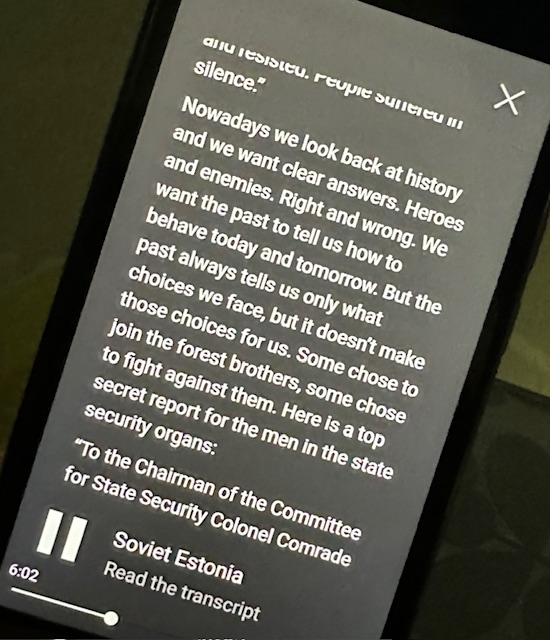
I'll begin with a museum in Estonia that I visited last fall: the Vabamu Museum of Occupations and Freedom in Tallinn. The permanent exhibit looks at during and after the Nazi and Soviet occupations of Estonia but importantly, as the website says, The focus on restoring and preserving freedom is central to Vabamu. Somewhat reluctantly I took an audio tour, which turned out to be fabulous, tremendously engaging, but also giving you the written text, so you could read if you didn't want to listen. As you'll see below, I took lots of photos of the text itself, to help me remember!
A key element of the exhibition is testimony from Estonians themselves, who were usually shown full size--so you really met them. I think of this museum as brave, because it embraces all of the grays of past, present, and future. For instance:
The exhibit also acknowledges the complexity of remembering Soviet times--that for many, there is also a complicated kind of nostalgia that plays in different ways for different memories.
The exhibit ends with contemporary testimonies and a chance to take a quiz to find out what kind of political person you would be in a newly independent Estonia--and you hear from people that represent all those perspectives.
Today, as I go back and read these texts that I saw last fall, they have so much resonance in our current place here in the United States. It's clear that we all have choices to make, but they may all be different. But we need to be asking these questions!
Special thanks to Martin Vaino, Curator and Head of Exhibitions who introduced us to the museum's work, and appreciation for this small exhibit on Ukraine, that used a dialogic format to encourage Estonians to reflect on their role in this conflict. Thanks also to the US Embassy in Estonia who supported my attendance at the ICOM-Exhibition conference and this museum visit.
It's been more than a year since I've posted. I continue to work with museums, historic sites, and other organizations in my role at the International Coalition of Sites of Conscience (six continents in 2023, though no so many planned for 2024). Russia's war on Ukraine continues and I continue to stand in awe of the bravery of colleagues and friends there. I continue to visit museums all over, and a continued joy is meeting new people and seeing new places.
But I haven't blogged in more than a year! Am I all the way done, as many bloggers I admire are? Do I have anything else to say? I decided to back up all my blog posts, all 605 of them with more than a million views overall. That's alot of something, though I'm not sure quite what! Should I move to a newsletter or something else? I'll try to spend some time in the next few months contemplating all this.
This week, it's been one full year since Russia launched a full-scale attack on Ukraine, a country I love deeply. I've been in awe of the courage of the Ukrainian people--both the people I know, wherever they are, and the people I read about in the news. It's clear that in addition to fighting on the battlefield, there are also battles being fought about culture and cultural heritage. In this grab-bag post, I just wanted to highlight some work I admire (there is so much more too!).
First, the power of a single voice. Nadia Parfan was a student of mine the very first year I went to Ukraine (2009). She also was good enough to serve as my translator sometimes when I returned to Ukraine. For some reason, I have such a clear memory of her attempting to explain post-Soviet museum culture to me as we walked up a set of steps. Not an easy explanation, for sure!
Her new short film, "I Did Not Want to Make a War Film," has just been featured on the New Yorker's website so it's gotten loads of attention already in the United States: you may have already come across it. If you haven't seen it yet, please take a watch. This is such a personal story, using the tools of filmmaking, friends, and family to help all of us understand, at least a small bit, about the ways in which the war is affecting everyone in Ukraine, not just on the battlefield. From her grandmother's prayers to the joy of returning to Kyiv, the city she loves, to that tamarind plant, it's just one story of the millions about this year of war.
Dozens of Ukrainian scholars have opened new conversations about Russia as a colonial power and about the ways in which that colonial power has meant that Ukrainian artists and artworks have been ignored, misnamed, or minimized in European and American museums. Last week at the Metropolitan Museum of Art in New York, I found at least two re-written labels on artworks, due, I feel sure, to the pressure of those scholars and journalists.
Artwork and labels from the Metropolitan Museum of Art. My own not-very-good photos.
I wish the Met had actually owned up to what the previous labels had said, as a way to open up a broader discussion, but at least the change was made. To learn more about Ukrainian art history and decolonization efforts, follow Oksana Semenik on Twitter at @ukr_arthistory, and for fascinating and important threads on Russia as a colonial power, follow Maxim Eristavi on Twitter @maximeristavi. Many, many more folks are doing this work as well.
Individual actions are joined by collective actions. ICOM-Ukraine, the national committee of the International Council of Museums, has actively worked to have ICOM take a strong stand. This past week ICOM-Germany did just that. ICOM-Germany is the largest national committee so this stand takes a significant message to the larger museum community. In a statement (read in full here) the committee said,
With immediate effect, ICOM Germany is boycotting the Russian National Committee as the national association under the Russian flag. In principle, the German National Committee will neither cooperate with ICOM Russia nor participate in events at which representatives of ICOM Russia or Russian museum colleagues are present. ICOM Germany is also demanding that the Russian National Committee be suspended at international level. To this end, talks with other ICOM committees and ICOM International are being intensified. The aim is to completely stop working with ICOM Russia and to exclude the Russian National Committee from the world association until further notice.
The board of ICOM Germany shows solidarity with all democratic, progressive and liberal institutions and people in Russia. It is aware that the exclusion will also affect employees in Russian museums who work for peace and justice. However, the cultural sector must not permanently claim a special role or postulate a general impression of innocence. The systematic looting of Ukrainian museums, which according to current knowledge is supported by Russian museum actors and is an example of ethical transgression, should no longer go uncommented. The reports and pictures from Ukrainian museums speak a clear language.
Fire extinguishers being delivered by HERI
So what can you, with your single voice do?
Listen, watch, read, and think critically.
Amplify good work being done. If you're a member of ICOM, can you encourage your national committee to join Germany? Can you take a look at your own collections?
Contribute financially if you are able. It seems as if local organizations/individuals on the ground are able to quickly deliver aid of all sorts than the big international ones (in my mind, World Central Kitchen is a notable exception and one I support for their work everywhere). In the museum world, there's the Museum Crisis Center, founded and run by Ukrainian museum workers which is supporting both institutions and individuals. The Heritage Emergency Response Initiative (HERI), also founded and run by Ukrainians, has focused on a wide range of support, much of it practical (generators and fire extinguishers, for instance). HERI is now broadening its work to consideration of what post-war recovery efforts will look like for the cultural heritage sections. All sorts of private citizens are raising funds to support both military and civilian needs. For instance, The poet/musician Sergey Zhadan raises funds for drones, trucks, and other equipment for the army--so far, more than 100 vehicles.
Zhadan, upon receiving the Peace Prize of the German Book Trade last fall gave a speech on language and war (full text in English here). And he ends with the future:
Like it or not, we will have to renew our sense of time, perspective, and continuity. We are fated to have a future. Moreover, we bear responsibility for it. Now, it is shaped by our visions, our convictions, our willingness to take responsibility. We will work at returning our sense of the future, since there’s just so much in our memories that demands our involvement tomorrow. We are all linked by this current that carries us, that won’t let us go, that unites us. We are all linked by our language. Even if, at a certain moment, its capabilities seem limited or insufficient. Nevertheless, we will be forced to return to it and its capabilities which give us hope that, in the future, there will not be any misunderstandings or anything left unsaid.
Dear Ukrainian colleagues and friends, the new visions, convictions, and willingness to take responsbility that Zhadan mentions, will surely bring a new peaceful future.
Maria Primachenko, A Dove Has Spread Her Wings and Asks for Peace.




%20(1).jpg)